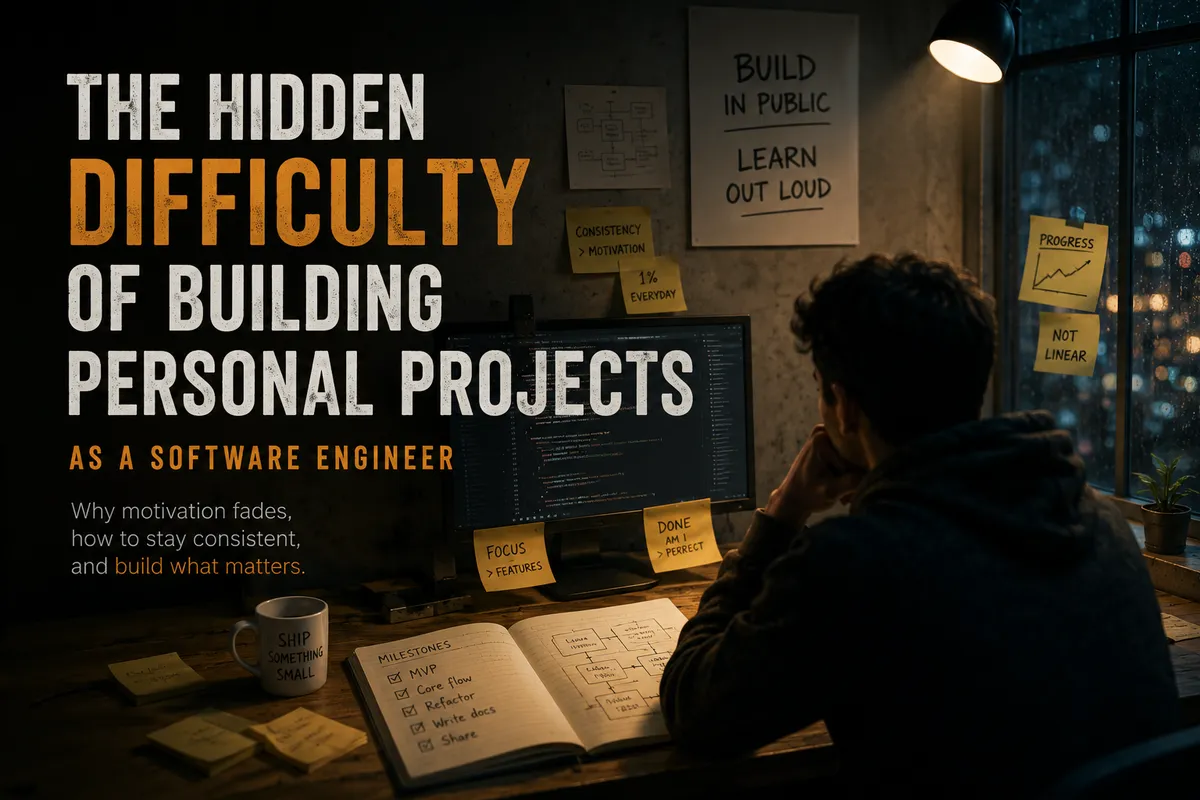
The Hidden Difficulty of Building Personal Projects as a Software Engineer
2026-07-24
Software Engineering has developed a culture where continuous learning, public visibility, and personal branding are increasingly treated as requirements rather than advantages. In a competitive job market, the boundary between professional growth and personal life can easily become blurred.
There is constant pressure to improve, learn new technologies, build impressive projects, contribute to open source, and demonstrate expertise publicly. For many engineers, personal projects have become one of the most common ways to develop skills and stand out from other candidates.
However, this article is not about how to build a successful project or how to create the perfect portfolio. Instead, it is an introspection about why maintaining motivation and working consistently on personal projects can be surprisingly difficult.
Why Personal Projects Feel Harder Than Professional Work
Working on a professional project is not easy. It can involve complex technical problems, difficult deadlines, and unfamiliar technologies. Yet, despite these challenges, it often feels easier to stay motivated.
The reason is simple: professional work comes with external incentives.
You are paid to solve problems. Your work has consequences. Customers are waiting for features, teammates depend on you, and your livelihood is connected to your ability to deliver results.
A personal project is fundamentally different.
There is usually no immediate financial reward, no customer waiting, no manager checking your progress, and no external pressure forcing you to continue. You have to create your own motivation and convince yourself that the effort is worth the time.
This creates a unique psychological challenge. You are not only the engineer building the software; you are also responsible for defining the problem, setting the goals, deciding the scope, and maintaining the discipline to finish.
The Psychological Cost of Building Something Nobody Asked For
In the current software job market, personal projects are often presented as a way to differentiate yourself. They can demonstrate technical ability, curiosity, and initiative.
Some engineers build small projects focused on learning a specific concept. Others attempt ambitious products with complex architectures, hoping they might become something bigger.
However, building a personal project can sometimes be psychologically harder than working on a professional project.
You have to make decisions without clear answers:
- What should I build?
- How much time should I invest?
- Is this project worth finishing?
- Should I add more features?
- Am I learning enough from this?
You also have to deal with all the frustrating parts of software development:
- writing boilerplate code
- debugging unexpected problems
- making architectural decisions
- refactoring old code
- maintaining motivation after the initial excitement disappears
And you do all of this without knowing whether anyone will ever use what you create.
Strategies to Make Personal Projects More Sustainable
Avoid unnecessary boilerplate
One of the easiest ways to lose motivation is spending most of your time rebuilding the same foundations.
If your goal is to learn a new technology or demonstrate a specific skill, avoid wasting weeks implementing generic features that are unrelated to your objective.
For example, if you want to demonstrate your knowledge of distributed systems, the interesting part is probably not building authentication and password reset flows for the fifth time.
Maintain trusted templates and reusable foundations for common components. Your personal projects should focus on what you are trying to explore, not on repeatedly rebuilding everything from scratch.
Define your motivation before starting
Before writing code, understand why you are building the project.
Are you trying to:
- learn a new language?
- understand a specific algorithm?
- practice system design?
- experiment with an architecture?
- create a product that people will use?
These goals require different approaches.
A learning project does not need production-level polish. A product idea does. Confusing these objectives often leads to unnecessary complexity and frustration.
Avoid accidentally building a startup
Many personal projects fail because their scope silently expands.
What starts as:
"I want to learn how databases work"
can quickly become:
"I will build a complete SaaS platform with authentication, billing, analytics, mobile apps, and a custom dashboard."
There is nothing wrong with building products, but recognize that a product requires significantly more effort than a technical experiment. It is tempting to imagine the recruiters in awe before your project, but building large projects is not free.
Build the smallest version that proves your idea. Once the core objective is achieved, additional features can be added if there is a good reason.
Track progress and define milestones
Large projects can become overwhelming because the finish line is unclear.
Breaking the project into smaller tasks creates a sense of progress and makes the work easier to maintain.
A simple task list can answer important questions:
- What have I already accomplished?
- What remains to be done?
- Am I still moving toward the original goal?
Consistency matters more than intensity. A project worked on regularly for a few months is usually more valuable than one that receives massive attention for two weeks before being abandoned.
Do not become the designer by accident
Many engineers underestimate how much time visual design consumes.
A beautiful interface can make a project more impressive, but designing a complete visual identity, component system, and user experience is almost a separate discipline.
Unless design is the skill you are trying to develop, avoid turning your engineering project into a design project.
Start with something functional. Improving an existing application later is often easier than trying to create a perfect experience from the beginning.
Create external sources of motivation
Even if you believe your project is too small or not impressive enough for recruiters, it can still create value.
Writing technical articles, documenting decisions, creating tutorials, or sharing lessons learned can transform a private project into something more meaningful.
A project does not have to become a successful product to be valuable. The knowledge gained, the problems solved, and the ability to communicate your reasoning are valuable outcomes themselves.
Conclusion
Personal projects are difficult because they remove the external forces that usually push us forward. They require us to create our own direction, motivation, and definition of success.
The goal should not be to spend every waking hour building software. Sustainable growth comes from deliberate practice, curiosity, and the ability to finish meaningful things.
A completed small project often teaches more than an ambitious unfinished one. The real skill is not only knowing how to build software, but knowing how to choose what is worth building and having the discipline to bring it to completion.